

Currently Not Collectible Status: Software & Workflow Guide
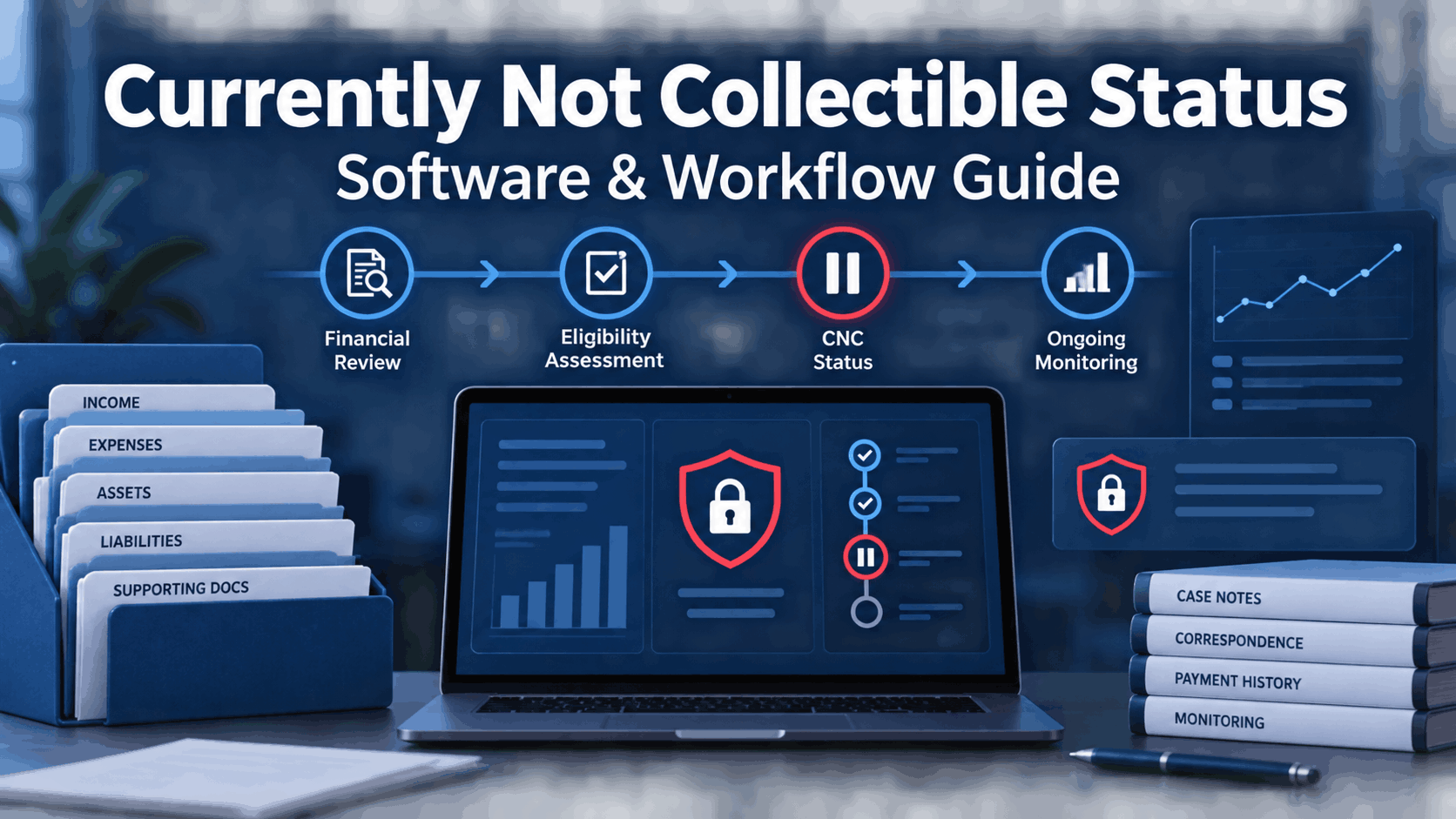
Not every resolution client can afford an Offer in Compromise payment or an Installment Agreement, even a reduced one. When a taxpayer's allowable expenses genuinely exceed their income, with no meaningful equity in assets, Currently Not Collectible (CNC) status — sometimes referred to by its internal IRS designation, status "53" — is the appropriate outcome. Getting the determination right, and documenting it correctly, is what this piece covers.
What Currently Not Collectible Status Actually Means
CNC status doesn't eliminate a tax debt. It tells the IRS to temporarily suspend active collection — no levies, no new liens initiated for the CNC period — because the taxpayer currently lacks the ability to pay. The debt remains, interest and penalties generally continue to accrue, and the IRS periodically reviews the taxpayer's financial situation to determine whether CNC status should continue. The Collection Statute Expiration Date keeps running during CNC status in most cases, meaning some clients in genuine hardship situations eventually see the debt expire entirely if their financial circumstances don't improve before the statute runs.
Determining CNC Eligibility
Eligibility comes down to a straightforward comparison: does the client's income cover their allowable expenses (under IRS National, Regional, and Local Collection Financial Standards for their household size and county) and leave nothing meaningful for the IRS to collect? If yes — and if the client doesn't have realizable equity in assets that could otherwise satisfy the debt — CNC is typically the right recommendation.
This is the same standards-based calculation used for Offer in Compromise and Installment Agreement eligibility, which is why a resolution platform that evaluates all three side by side (rather than requiring separate manual analysis for each) saves meaningful time on intake.
How PitBullTax Determines CNC Eligibility
PitBullTax's Resolution Evaluation tool runs Currently Not Collectible "53" eligibility as part of the same analysis it performs for Offer in Compromise and Installment Agreement determinations — comparing the client's income, expenses, family size, and assets against current IRS Standards automatically, and showing CNC eligibility "based on taxpayers' lack of required income and assets needed to repay their tax liability," side by side with the other two resolution paths. That side-by-side view matters in practice: a client who looks like a CNC candidate on the surface sometimes turns out to qualify for a small Partial Pay Installment Agreement instead, once the actual numbers are run — and vice versa.
Once CNC is confirmed as the appropriate path, PitBullTax's integrated IRS forms module auto-populates the required financial statement (typically Form 433-A or 433-F) from data already collected during intake, reviewable through an enhanced forms preview.
Managing CNC Cases After Approval
CNC status is not a one-time filing — it requires ongoing attention:
Periodic IRS review. The IRS revisits CNC cases periodically to check whether a taxpayer's financial situation has improved. Being prepared for that review means keeping current financial documentation on file, not scrambling when the IRS asks.
CSED tracking. Because the collection statute typically keeps running during CNC status, knowing exactly where a client stands on their 10-year CSED matters — some clients in extended CNC status will see their liability expire before their financial situation changes.
Re-evaluation triggers. A new job, an inheritance, or a change in household composition can end CNC eligibility. Ongoing account monitoring — not just the initial determination — is what catches these changes before the IRS does.
PitBullTax's optional IRS Transcript Monitoring add-on supports this by tracking a client's account on a schedule and sending automatic alerts when new activity posts, which is particularly relevant for CNC clients given how long these cases can remain open.
Documentation and Client Communication
CNC clients are, by definition, in financial hardship — client communication in these cases often requires more patience and more reminders than a straightforward Installment Agreement case. PitBullTax's bilingual Client Questionnaire and automated Client Questionnaire Reminders (by text and email) help keep documentation flowing without requiring manual follow-up from staff.
Frequently Asked Questions
How long does Currently Not Collectible status typically last?
There's no fixed duration — the IRS reviews CNC accounts periodically (often every one to two years, though timing varies), and status continues as long as the taxpayer's financial situation remains unchanged. Some clients remain in CNC status until the Collection Statute Expiration Date passes.
Does CNC status stop all IRS contact?
It stops active collection enforcement (levies, new liens in most cases), but it doesn't erase the debt or eliminate all IRS correspondence — clients will still receive periodic balance notices, and interest continues to accrue.
Can a CNC case later convert to an Offer in Compromise?
Yes. Financial circumstances change, and a client in CNC status who later develops equity in assets or excess monthly income may become an OIC or Installment Agreement candidate. This is exactly why re-running Resolution Evaluation periodically — not just at initial intake — matters for CNC cases specifically.
Getting Started
To see how Resolution Evaluation determines CNC eligibility alongside OIC and Installment Agreement options on an actual case file, PitBullTax offers a 7-day free trial.
For the complete resolution software picture — including how OIC and Installment Agreement determinations work — see our complete guide to tax resolution software.
Sources: PitBullTax Why PitBullTax page (pitbulltax.com/page/irs-back-taxes-solutions.html); PitBullTax Resolution Evaluation feature (pitbulltax.com/page/resolution-evaluation.html)