

IRS Installment Agreement Software: Streamline Case Management
IRS Installment Agreement Software: Streamlining Case Management
Installment Agreements are the most common IRS resolution outcome — far more clients end up on a payment plan than get an Offer in Compromise approved or qualify for Currently Not Collectible status. That makes it easy to underestimate: there isn't just one kind of Installment Agreement, and picking the wrong structure (or miscalculating the payment) can cost a client money or get the agreement rejected outright. Here's what installment agreement software should handle, and how PitBullTax approaches it.
It's Not Just "Set Up a Payment Plan"
The IRS offers several distinct Installment Agreement structures, and which one applies depends on the balance owed, the client's ability to pay, and the time remaining on the Collection Statute Expiration Date:
- Guaranteed Installment Agreement — for smaller balances, generally available without a full financial disclosure.
- Streamlined Installment Agreement — for balances under a set threshold, with simplified terms and no full Collection Information Statement required in many cases.
- Partial Pay Installment Agreement (PPIA) — for clients who can pay something but not the full balance before the CSED runs, based on a full financial analysis.
- 6-Year Full Pay / 1-Year Rule / Full Pay Over Remaining Statute agreements — structured around paying the full balance across specific timeframes tied to the client's financial capacity.
Choosing correctly requires the same kind of financial analysis used for an Offer in Compromise determination — comparing the client's actual income and allowable expenses (under IRS National, Regional, and Local Standards) against what different agreement structures would require monthly.
What the Software Should Calculate
- Which agreement type the client actually qualifies for, based on balance owed, income, and CSED timing — not a generic "pick a payment amount" form.
- The recommended monthly payment, run against current IRS allowable-expense standards for the client's household size and county.
- Whether a Partial Pay structure makes more sense than a full-pay agreement, given how much time remains before the statute expires — a distinction that materially changes how much the client ultimately pays.
- The correct supporting forms — typically Form 9465 and, for larger balances or PPIAs, a full Form 433-A or 433-F financial statement.
How PitBullTax Handles Installment Agreement Cases
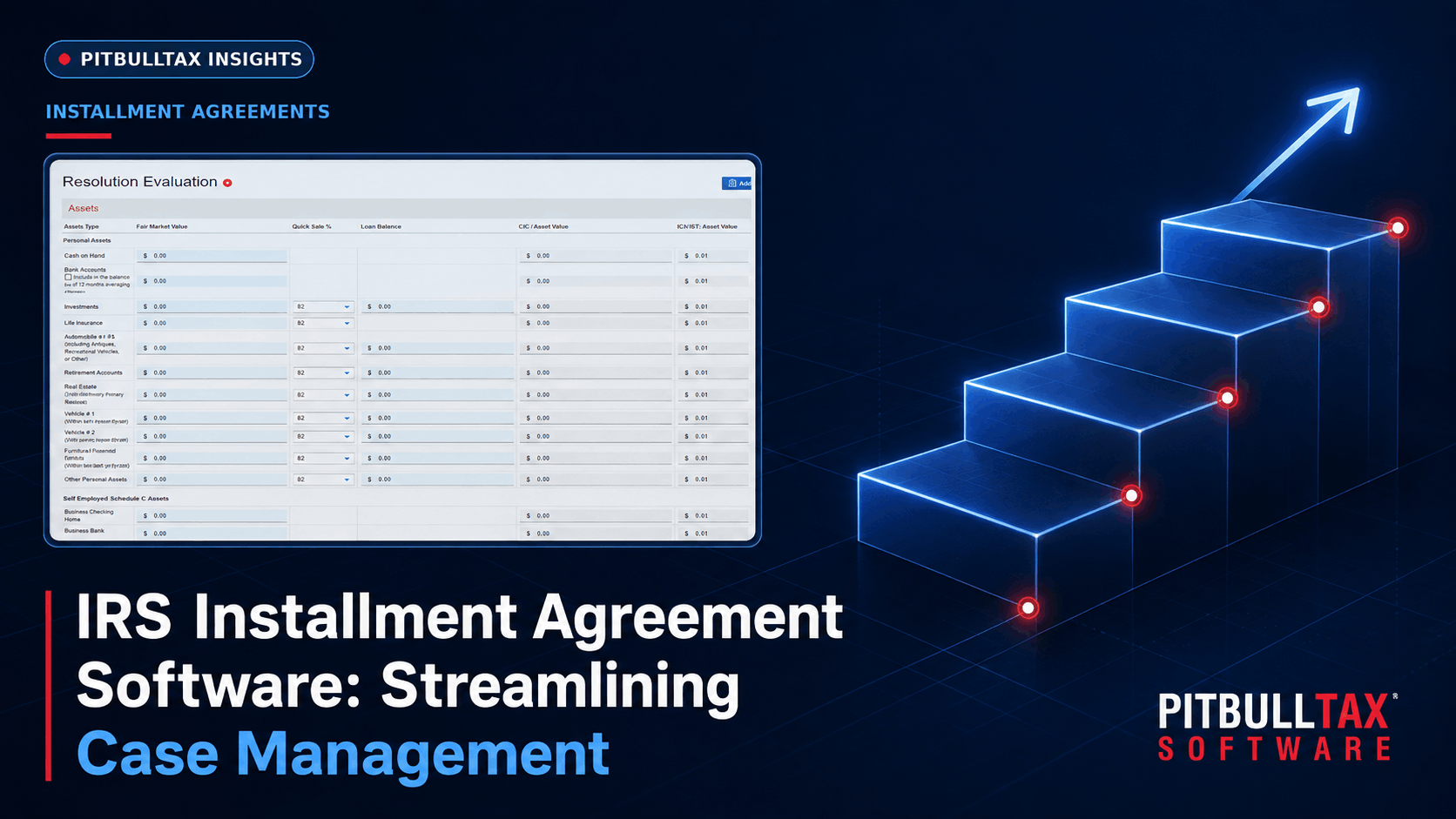
PitBullTax's Resolution Evaluation tool determines Installment Agreement eligibility as part of the same analysis it runs for Offer in Compromise and Currently Not Collectible status — using the client's income, expenses, family size, and assets against IRS Standards to recommend a monthly payment amount automatically, rather than requiring manual lookups against the current Collection Financial Standards tables.
Because the software applies "a proprietary matrix encompassing the rules for Streamlined, 6 Year Full Pay, 1 Year Rule, Full Pay Over Remaining Statute Installment Agreements, Partial Pay Installment Agreements and Currently Not Collectible Status '53' cases," practitioners can switch between resolution strategies for the same client and have the software automatically recalculate — useful when a client doesn't qualify for the agreement type you initially expected, or when new financial information changes the picture mid-case.
Once the agreement type is determined, PitBullTax's integrated IRS forms module auto-populates Form 9465 and any required 433 series form from data already in the case file, reviewable through an enhanced forms preview before submission.
Monitoring an Agreement After It's Approved
An Installment Agreement isn't the end of the case — it needs to be monitored for default risk. A missed payment, a new balance from an unfiled return, or a lapse in current-year compliance can terminate the agreement and put the client back in active collections. PitBullTax's optional IRS Transcript Monitoring add-on tracks the client's account and sends automatic alerts when new activity posts, so a potential default surfaces early rather than after the IRS has already taken action.
Case and Payment Tracking
For firms managing a volume of Installment Agreement cases, the optional Case Management and Billing add-on adds case tracking, a calendar, and time tracking, while the Payment Processing add-on lets you charge client fees directly through the software and set up scheduled partial payments — relevant for resolution clients who are, by definition, already managing tight cash flow and may need their own fee arrangement structured in installments.
Getting Started
If Installment Agreement cases make up a meaningful share of your practice, the fastest way to evaluate whether automated eligibility and payment calculations actually save time is to run them against a real case file. PitBullTax offers a 7-day free trial for this purpose.
A Note on CSED Timing and Agreement Structure
One detail newer resolution practitioners sometimes miss: the type of Installment Agreement a client enters can interact with the Collection Statute Expiration Date in ways that materially change the total amount paid. A Partial Pay Installment Agreement, by design, may not fully repay the balance before the CSED runs — meaning the remaining debt can legally expire. A full-pay agreement structured over too long a timeframe, by contrast, can end up collecting more than the IRS could have otherwise recovered before the statute closed. Running the CSED calculation alongside the payment analysis — not as a separate afterthought — is part of what makes an accurate Installment Agreement recommendation different from simply dividing a balance by 72 months.
Frequently Asked Questions
Can a client have more than one Installment Agreement at a time?
Generally, no — a new tax liability (such as a subsequent year's balance) typically needs to be incorporated into the existing agreement rather than creating a separate one, which is another reason ongoing compliance monitoring matters for clients already on a payment plan.
What happens if a client's financial situation changes mid-agreement?
An existing Installment Agreement can be renegotiated if a client's income or expenses change significantly — a reduction in payment amount, a conversion to Currently Not Collectible status, or in some cases eligibility for an Offer in Compromise instead. This is exactly the kind of change that account monitoring is built to catch early.
Does an Installment Agreement stop penalties and interest from accruing?
No — penalties and interest generally continue to accrue on the unpaid balance during an Installment Agreement, though the failure-to-pay penalty rate is typically reduced once an agreement is in place. This is worth explaining clearly to clients up front, since it affects how much they'll ultimately pay over the life of the agreement.
For the full picture of how resolution software handles Installment Agreements alongside Offer in Compromise and Currently Not Collectible determinations, see our complete guide to tax resolution software.
Sources: PitBullTax Why PitBullTax page (pitbulltax.com/page/irs-back-taxes-solutions.html); PitBullTax Resolution Evaluation feature (pitbulltax.com/page/resolution-evaluation.html); PitBullTax Optional Features (pitbulltax.com/page/features.html)