

IRS Transcript Analysis: Turning Raw Data Into Client Insights
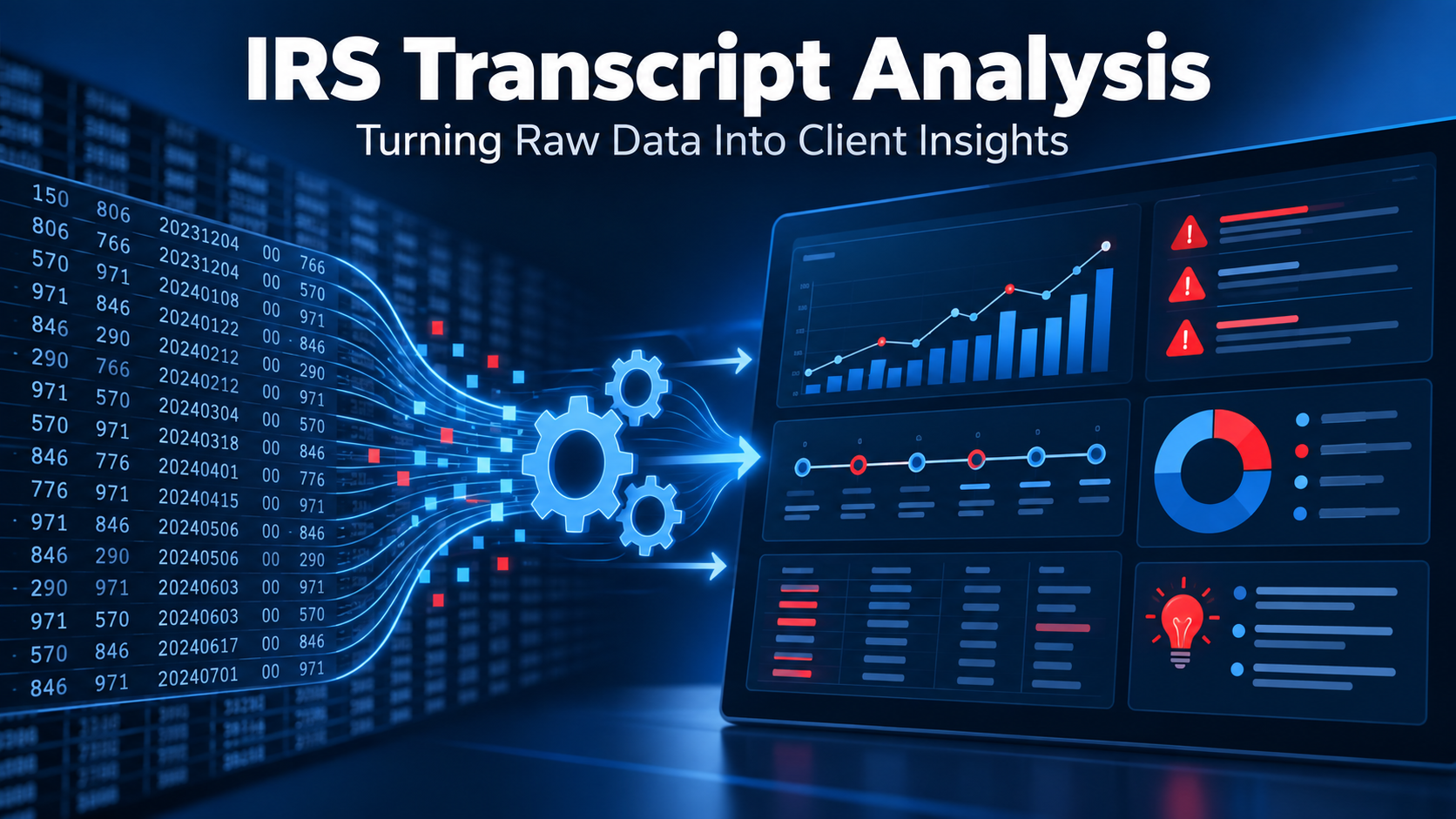
An IRS account transcript, read raw, is a wall of transaction codes, dates, and dollar figures that means very little to a client and takes real experience to interpret quickly even for a practitioner. Transcript analysis is the process — increasingly automated — of translating that raw data into the specific answers a resolution case actually needs. Done by hand, that translation takes an experienced practitioner 1 to 2 hours for a typical 5 to 6 year case. Automated, it takes under 2 minutes. Here's what a proper analysis surfaces, and how to get there.
What Raw Transcript Data Actually Contains
An IRS Account Transcript lists every transaction on a taxpayer's account by year: original assessment, penalties (failure-to-file, failure-to-pay, accuracy-related), interest accruals, payments, and any adjustments — each tagged with an IRS transaction code (TC) and a date. A Wage & Income Transcript separately lists everything third parties reported to the IRS about the taxpayer's income (W-2s, 1099s). Reading these correctly requires knowing what each transaction code represents and how they interact across years — which is exactly the kind of pattern-recognition work that benefits from automated analysis rather than manual review.
What a Proper Transcript Analysis Should Surface
Current tax liabilities, penalties, and interest — by year. Not just a single balance figure, but a breakdown of what's principal, what's penalty, and what's interest, since penalty abatement strategy depends on knowing exactly which penalties were assessed and why.
Collection Statute Expiration Date (CSED). The IRS generally has 10 years from assessment to collect. Certain events — an Offer in Compromise under review, a bankruptcy filing, specific collection due process requests — toll (pause) that clock. An accurate CSED calculation has to account for any tolling events reflected in the transcript, not just count 10 years from the original assessment date.
First-Time Penalty Abatement eligibility. This requires confirming the taxpayer has a clean compliance history for the prior three years — a check that's easy to get wrong by relying on a client's memory instead of the actual filing and payment record in the transcript.
Trust Fund Recovery Penalty exposure. For business clients with payroll tax issues, the transcript can reveal whether TFRP assessment activity has begun against a responsible individual — critical for setting expectations before that individual is formally pursued.
Bankruptcy dischargeability windows. Certain tax debts become dischargeable in bankruptcy once specific timing conditions are met (return filed on time, assessment old enough, no fraud). The transcript's assessment and filing dates determine exactly when that window opens.
Compliance status. Whether the taxpayer is current on required filings and estimated payments — a prerequisite the IRS generally requires before approving an Offer in Compromise or Installment Agreement.
The Time Cost: 1-2 Hours by Hand vs. Under 2 Minutes
For an experienced practitioner, reviewing and analyzing 5 to 6 years of account transcripts by hand takes 1 to 2 hours. PitBullTax generates the same analysis in under 2 minutes.
That gap widens as cases get bigger. Resolution work frequently calls for analyzing 20 to 25 years of account data, a volume that is effectively impractical to read line by line but that the software handles in the same couple of minutes. For newer practitioners still building transaction-code fluency, the manual figure runs higher.
Multiply 1 to 2 hours across an active caseload and transcript review alone consumes a disproportionate share of the week, before any case strategy work begins.
How PitBullTax Automates Transcript Analysis
PitBullTax's IRS Transcripts tool generates the full analysis automatically the moment transcripts are retrieved — no manual code-by-code review required. Reports cover current tax liabilities, penalties, and interest; CSED calculations; First-Time Penalty Abatement eligibility; unpaid TFRP calculations; earliest bankruptcy dischargeability dates; compliance status and Wage & Income summaries; Federal Tax Lien, audit, and bankruptcy indicators; full account transcript summaries and payment history; and civil penalty detail — generated instantly and available for both individual and business clients, in English and Spanish.
Reports can be branded with your firm's logo, which makes the analysis useful as a client-facing deliverable as well as an internal working document — turning what used to be an internal-only research task into something you can hand a client during an initial consultation to demonstrate exactly what their IRS account shows.
Getting a Result Practitioners Have Actually Reported
Louise Hartford, a PitBullTax user, credits the transcript analysis specifically with a concrete outcome: "Thanks to those IRS transcript reports and their analysis, I was able to get over $506,000 of penalties abated in one phone call for one client." That kind of result depends on the analysis surfacing the right penalty-abatement opportunity quickly enough to act on it — the core value of automating the read.
Individual vs. Business Transcript Analysis
Business transcript analysis introduces detail individual transcripts don't require — most notably Trust Fund Recovery Penalty exposure tied to payroll tax deposits, and entity-level compliance status that has to be checked separately from any individual owners' personal filings. PitBullTax generates dedicated business transcript reports alongside individual reports, recognizing that a business client's account analysis genuinely requires a different report structure, not just the same report applied to a different SSN/EIN.
Frequently Asked Questions
Can transcript analysis be wrong?
The analysis is only as accurate as the underlying transcript data from the IRS, and IRS records occasionally contain errors or lag behind recent activity by a few weeks. A generated report should inform your case strategy, not replace professional judgment about whether a figure looks inconsistent with what you already know about the client.
Does transcript analysis replace the need to talk to the client about their situation?
No — it replaces manual reading of raw transaction codes, not the conversation about the client's actual financial circumstances, which still requires direct intake for the Resolution Evaluation to determine OIC, IA, or CNC eligibility.
Try It on a Real Transcript
Because the value of transcript analysis is easiest to judge against an actual account, PitBullTax offers a 7-day free trial so practitioners can pull a real client's transcripts and review the generated reports directly.
For the complete guide to PitBullTax's transcript delivery, reporting, and monitoring platform, see our complete guide to IRS transcript delivery and analysis.
Sources: PitBullTax IRS Transcripts page (pitbulltax.com/irs-transcripts.html); PitBullTax homepage testimonials (pitbulltax.com)